
Key takeaways
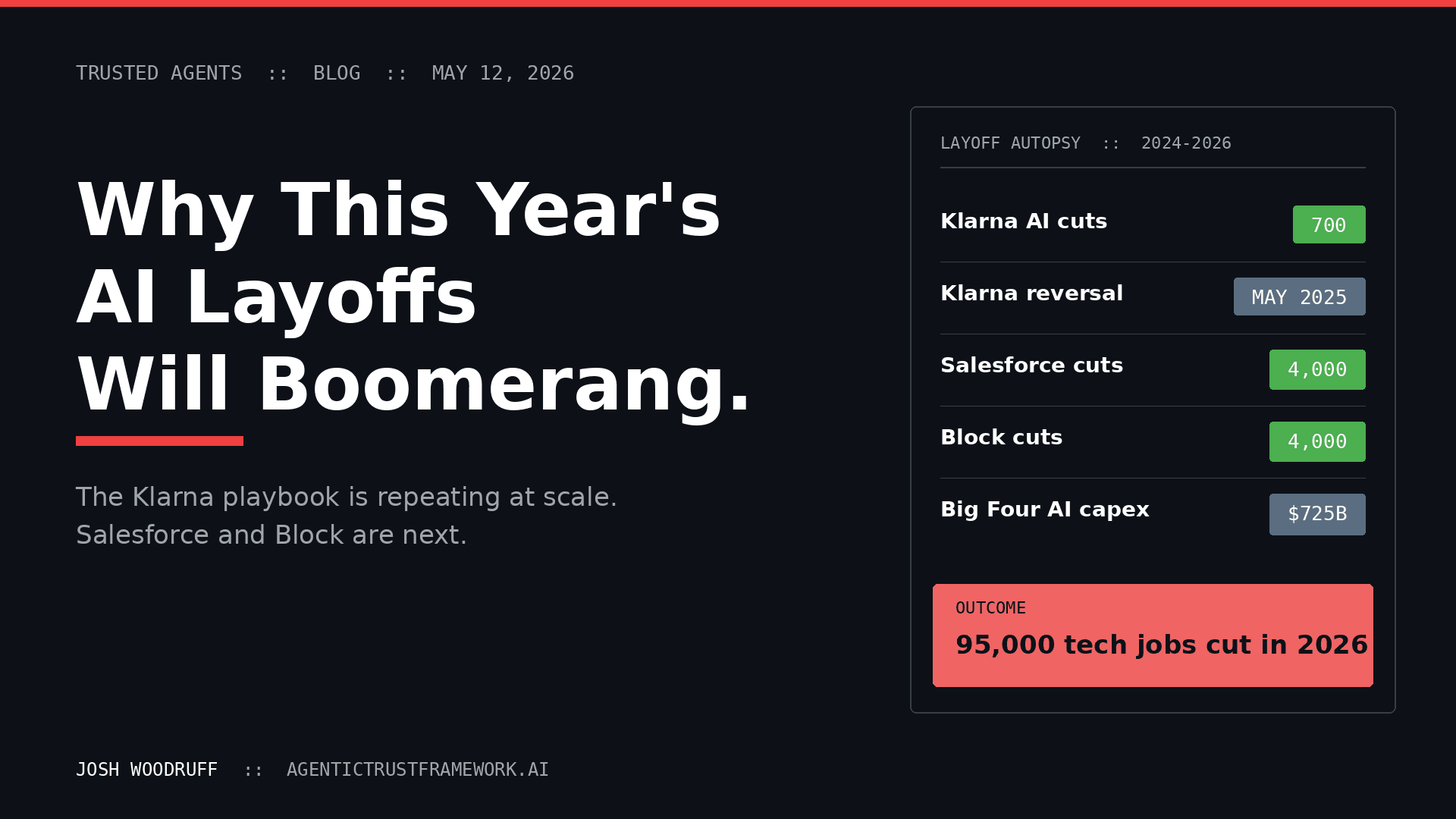
- Klarna cut 700 customer service jobs to AI in February 2024 and began hiring humans back in May 2025 after customer satisfaction collapsed.
- The Big Four (Google, Amazon, Meta, Microsoft) committed $725 billion to AI capex in 2026, up 77% year over year, funding most layoffs through GPU spend rather than AI replacement.
- Salesforce CEO Marc Benioff announced 4,000 customer support cuts in September 2025 with the on-the-record explanation "I need less heads." Block went from 10,000 to under 6,000 employees in March 2026, citing AI directly.
- Median tier-1 AI deflection in 2026 enterprise customer service sits at 41.2%, with the ceiling at 55-70%. Companies cutting 40-50% of customer-facing headcount are betting on numbers most production teams haven't hit.
- The HiddenLayer 2026 enterprise survey found 88% of organizations had a confirmed or suspected AI agent security incident last year. 31% don't know whether they had one. 53% withheld breach reporting.
What happened at Klarna, and why did the AI customer service layoffs fail?
Klarna replaced 700 customer service roles with an OpenAI-powered chatbot in February 2024 and reversed the decision in May 2025 because customer satisfaction collapsed. CEO Sebastian Siemiatkowski admitted that cost had become a "too predominant evaluation factor," and that quality had dropped too far. Klarna began rehiring humans for VIP customer service and named the AI bet as a productivity story that broke trust.
The autopsy comes down to three decisions that worked individually and failed together. First, Klarna set a volume target ("AI does the work of 700 agents") with no specification of what kind of work. Bounded queries like order status got routed to AI alongside unbounded ones like chargeback disputes. Second, the "talk to a human" option moved deep into the menu structure, or got removed entirely in some flows. Third, the dashboard measured cost per ticket, which fell, while churn and repeat contacts climbed off the dashboard. The expense moved from payroll to lost customers.
The Klarna case is well-documented in Fortune's May 2025 coverage and the Bloomberg piece on "AI washing." The pattern matters now because Salesforce, Block, and a dozen companies you'll read about by year-end are running the same playbook.
Are the 2026 tech layoffs really about AI replacing workers?
Partially. The dominant story behind the 95,000 tech layoffs in 2026 is capex replacing headcount, not AI replacing workers. The Big Four (Google, Amazon, Meta, Microsoft) committed $725 billion to AI infrastructure spending in 2026, up 77% from last year. Mark Zuckerberg told Meta staff plainly that the May 2026 cuts are a direct consequence of the AI infrastructure budget.
There's a second, narrower story inside the same numbers. A smaller group of companies is putting AI agents directly into roles where the work is more than pattern-matching. Customer support is the most visible example. The same pattern shows up in marketing AI, outbound sales, and content moderation. That subset is the Klarna risk. Block went from 10,000 to under 6,000 employees in March 2026, with Jack Dorsey citing "the growing capability of AI tools to perform a wider range of tasks." Salesforce CEO Marc Benioff announced 4,000 customer support cuts in September 2025 with "I need less heads."
These two stories deserve separate treatment. Capex replacing headcount is a structural finance shift. AI replacing customer-facing humans is a product bet with a six-month boomerang window. Confusing the two leads to the wrong response from leadership.
Which companies are most at risk of repeating the Klarna reversal?
Four industries concentrate the risk: fintech, healthcare, retail and e-commerce, and B2B services. Each has long-tail customer interactions that current AI handles poorly. Klarna is the published fintech example. Block is the current bet to watch in the same vertical. The HiddenLayer 2026 enterprise survey found 88% of organizations had a confirmed or suspected AI agent security incident last year. In healthcare, that figure rose to 92.7%.
Fintech. Long-tail tickets are disputes, fraud claims, and account access issues. Regulatory exposure is high. Customer trust is the product.
Healthcare. Long-tail tickets are billing disputes, prior-auth questions, and prescription escalations. The escalation path is a compliance requirement, not a UX choice. State variation makes the implementation harder.
Retail and e-commerce. Long-tail tickets are lost packages, return disputes, and account compromises. Customers with bad AI experiences post to social media within minutes. The reputational damage outruns the cost savings.
B2B services. Long-tail tickets are contract disputes, SLA violations, and account-level escalations. One bad AI interaction with the wrong account can kill a $400K renewal. Companies with named-account structure deploying AI as if they had transactional volume are the highest-risk cohort.
If your business operates in any of these four, the Klarna pattern is closer than the cost dashboard suggests.
What is the "bounded job trap" in AI customer support?
The bounded job trap is the failure pattern that hits when a company deploys AI on customer-facing work without separating bounded queries (order status, password resets) from long-tail queries (escalations, policy exceptions, emotional edge cases). AI handles bounded work well. It fails long-tail work loudly. Companies that don't separate the two end up routing both kinds to the AI and watching customer trust collapse.
The current production data for AI customer service: median tier-1 deflection sits at 41.2% across enterprise CX programs in 2026, with the top quartile reaching 58.7%. The honest analyst consensus puts the realistic ceiling for current models at 55-70% of incoming volume. Companies announcing customer support cuts of 40-50% are betting on numbers most production teams haven't hit yet.
The working pattern is straightforward. AI owns the routine. Humans own the judgment calls and accountability when things go wrong. Klarna inverted that pattern by treating all customer support as bounded. The bet showed up on the cost dashboard for 14 months before it showed up on the retention chart.
How does the measurement asymmetry hide AI failure?
Leaders watch cost per ticket and average handle time. Both improve when AI handles more volume. Customers measure something else: whether the AI helped, whether they had to fight to find a human when the script failed, whether the situation got resolved or required a callback. Most companies track customer-side metrics like CSAT and contact rate. Few cross-reference them against AI deployment dates inside a 30-day window.
Klarna ran 14 months between the layoff announcement and the public reversal. The CSAT and retention signal was visible inside the first 90 days. Nobody looked because the cost dashboard told a happier story. This is the measurement asymmetry: cost metrics and customer metrics live in different reviews, on different cycles, with different owners.
The structural fix is straightforward. Cost per ticket and CSAT per query-type need to land on the same page in the same review cycle. If your CFO and your Chief Customer Officer are reading different dashboards, the gap between confidence and reality is going to compound silently until a Fortune piece breaks it.
What controls actually catch the Klarna pattern before customers do?
The Agentic Trust Framework (ATF) names three controls every AI customer support deployment needs. The Klarna pattern fails at all three.
Allowed to do (the action allowlist). A written list of every action the AI is permitted to take, with the business conditions on each one. Most production teams have this at the tool-registry level (the AI can call the refunds API) but skip the business-rule layer (only refunds under $50 on accounts in good standing). The agent gets technical permission to do something it doesn't have business permission to do.
How you verify it (the monitoring signal). Daily monitoring at the customer-outcome level, not just system metrics. Token usage going up is not the same as CSAT going down. If AI-handled CSAT is diverging from human-handled CSAT, the AI is degrading the experience even when the technical metrics look clean.
How quickly you contain it when it drifts (the response mechanism). A real-time circuit breaker that disables AI actions per session if certain thresholds get hit (refund rate, escalation rate, repeat-contact rate). An audit cycle that runs on anomalies daily, not on aggregates quarterly.
The CSA-published Agentic Trust Framework documents all three with implementation guides. The pattern works for any AI customer-facing deployment, not just the ones currently announcing cuts.
What can a CEO do this week to avoid being the next Klarna?
Six moves to take this week.
1. Map every AI customer-facing tool in your environment. Not the policies. The tools actually running. Block's CEO didn't have a count of his own teams' AI pilots before he announced the layoff. Don't be that CEO.
2. Define the action allowlist for each one. Write down what each tool is allowed to do. Where it hands off to a human. If you can't write the allowlist, the tool doesn't have one.
3. Find your long-tail tickets. Pull last quarter's customer support data. Identify the categories that took more than three touches to resolve. Those are the ones AI will mishandle. Route them to humans by default, not by exception.
4. Build the escape valve. Every AI customer-facing interaction needs a one-click route to a human. Visible. No friction. Klarna's mistake was making the route invisible. The retention drop showed up two quarters later.
5. Cross-reference the dashboards. Put cost per ticket and CSAT per query-type on the same page in the same review cycle. If your CFO and your CCO are reading different reports, the gap between confidence and reality is going to compound silently.
6. Run the maturity check. What stage is each AI customer support deployment at? If you're operating like Stage 4 and reality is Stage 2, you're inside the Klarna window. Pull back, add the controls, then expand.
Frequently asked questions
Is the Klarna pattern an AI failure or an implementation failure?
It's an implementation failure that looks like an AI failure. The AI did exactly what it was told. The decisions about what kinds of tickets to route, where to put the human escape, and which metrics to track were human decisions made by VPs, directors, and heads of operations. Each decision was rational inside its own KPI. Together they produced the customer experience that bled trust.
How long after deploying AI in customer support does the Klarna pattern show up?
The CSAT signal appears inside 90 days. The retention signal takes 12-18 months. Klarna's public reversal came 14 months after the original announcement. Companies that monitor at the customer-outcome level catch it in the 90-day window. Companies that monitor only cost dashboards see it when a Fortune piece breaks it.
How is "AI capex replacing headcount" different from "AI replacing workers"?
AI capex replacing headcount is a financial substitution. Companies fund the AI infrastructure budget by reducing payroll in other areas. The reduced roles often have nothing to do with the AI being built. AI replacing workers is a direct substitution where AI takes over a specific job function (customer service, marketing copy, basic coding). The first is the dominant 2026 story. The second is rarer and more dangerous when deployed without controls.
What's the difference between Klarna and Salesforce or Block?
Klarna ran the experiment first and published the reversal. Salesforce announced 4,000 customer support cuts in September 2025 (Marc Benioff: "I need less heads") and hasn't reversed yet. Block announced 4,000 cuts in March 2026 with Jack Dorsey citing AI capability. Both companies are inside the same 6-month boomerang window Klarna was in for most of 2024.
Where does the Agentic Trust Framework fit in customer support deployments?
The ATF's three controls (allowed to do, verified, contained when it drifts) map directly to the operational decisions Klarna fumbled. The framework provides a written boundary on each AI deployment, an action-level monitoring layer, and a real-time containment mechanism. Most production teams have one of the three. The Klarna pattern requires all three.
Should we deploy AI in customer support at all?
Yes, with structured limits. AI handles bounded work (order status, password resets, FAQ-type queries) at a 55-70% deflection ceiling. The mistake is deploying AI on the long tail (escalations, policy exceptions, emotional edge cases) and treating the cost savings as if they covered both. Map the bounded work, deploy AI there, keep humans on the long tail, monitor for divergence.
Don't write that November memo. The free assessment at verifiedagents.ai shows you which of the three ATF controls your company is missing. It's ten minutes. And it gives you what you need to fix the gap before customers find it.