
Every CISO I talk to right now is asking the same question: "If we let the business use these agents, how do I make sure I'm not explaining a breach to the board next quarter?"
Last week, the Cloud Security Alliance put numbers behind why they're right to worry.
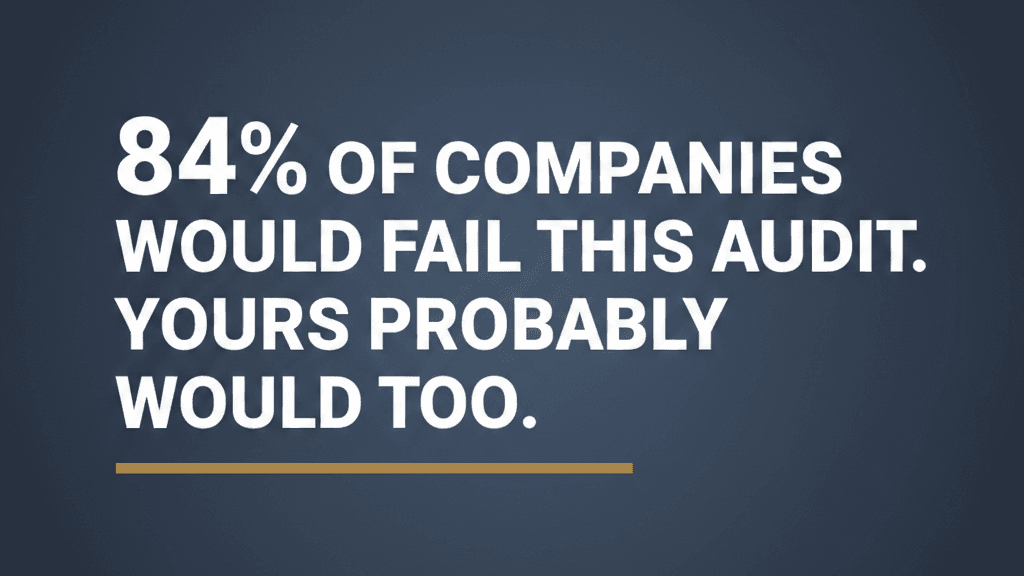
CSA surveyed 285 IT and security professionals about how they manage AI agents. 84% said their organization would fail a compliance audit focused on agent behavior or access controls. Not "might struggle." Would fail.
Only 18% are highly confident their identity systems can manage AI agents. Nearly half still use static credentials (fixed passwords or keys that never change) to control agent access. And 79% don't maintain a real-time registry of their agents. They can't tell you which ones are active, what they can reach, or what they did yesterday.
Why Do AI Agent Projects Keep Failing?
A lot of this never shows up in survey data.
I recently helped a consultant whose AI agent projects kept failing. Not because of model quality. The demos looked incredible. He was genuinely trying to help his clients. But production collapsed every time.
One project used an AI agent to send meeting confirmation emails. Important ones, where getting the details right counts. The agent worked great 98% of the time. But 2% of the time, it sent confirmations to the wrong person. Wrong distribution list. Wrong meeting time. If the agent wasn't given explicit instructions on time zones, it invented what it thought it should do. If it couldn't find a person, it searched the wrong places for a replacement.
2% sounds small. It's not. When real people have to own the fallout from an AI mistake, even a small error rate is intolerable. Leadership pulled the plug. Months of work, gone. Not because the AI wasn't smart enough. Because nobody built the controls to catch what it got wrong.
That's the gap this CSA survey is measuring. Companies aren't just missing security controls.
They're skipping the maturity curve entirely, going from demo to full autonomy and hoping nothing breaks.
What Happens When Nobody Is Watching the AI?
A manager let an AI drafting tool auto-fill performance review comments. Never reread them before submitting. The tool pulled in the wrong person's achievements and pasted them into multiple employees' reviews. People opened their reviews and saw feedback about projects they'd never worked on.
No CISO got a call about that. No headline. But every employee who read that review now questions whether their manager actually sees their work. Trust, gone. LinkedIn profiles updated. From a tool nobody thought to double-check.
Multiply that across an organization deploying hundreds of agents by next year (which 70% of CSA's respondents expect), and you start to see why 84% would fail that audit.
A fintech client summed it up during a Shadow Agent deep dive we did together: "So we built an army of digital workers with more access than most employees, and I can't even see how many there are."
That's the whole problem.
What Can You Do About AI Agent Risk This Week?
You don't need a six-month governance project to start closing these gaps. Here are four things you can do right now.
First, ask your security team: "Do we have a real-time inventory of every AI agent in our environment?" If the answer takes more than five minutes, that's your first project.
Second, pick your most active AI agent and map its access. What systems can it touch? What data can it read? If the answer is "everything," that's the problem, and it has a fix.
Third, ask: "If one of our agents sent the wrong information to the wrong person tomorrow, how would we know? How fast could we contain it?"
Fourth, look at the last 10 outputs from any AI tool your team uses. Read them like an auditor would. Anything surprise you?
How Do You Build Real Governance for AI Agents?
I built the Agentic Trust Framework to close exactly these gaps. CSA published it three days before this survey dropped. The principle is straightforward: if you can't identify an agent, monitor its behavior, limit its access, contain it when something goes wrong, and trace its actions back to a human, you don't have governance. You have hope.
The framework covers five core elements: Identity, Behavioral Monitoring, Data Governance, Segmentation, and Incident Response. It adapts Zero Trust principles (never trust, always verify) specifically for AI agents. The Cloud Security Alliance published it as an open specification in February 2026, and it's available on GitHub.
The companies that will pass an AI agent audit next year aren't the ones with the biggest budgets. They're the ones where someone asked these questions first.
Frequently Asked Questions
What percentage of companies would fail an AI agent audit?
According to a Cloud Security Alliance survey of 285 IT and security professionals, 84% of organizations would fail a compliance audit focused on AI agent behavior or access controls. Only 18% are highly confident their identity systems can manage AI agents.
Why do AI agent projects fail in production?
Most AI agent projects fail not because the AI isn't capable, but because organizations skip building the controls needed to catch errors. Common failures include agents sending information to wrong recipients, accessing unauthorized systems, and making decisions without human oversight. RAND Corporation research shows AI projects fail at twice the rate of traditional IT projects.
What is a Shadow AI agent?
A Shadow AI agent is an AI tool or automated system running in your organization that IT and security teams don't know about. 79% of enterprises deploying AI agents don't maintain a real-time registry of their agents, meaning they can't track which ones are active, what data they access, or what actions they take.
What is the Agentic Trust Framework?
The Agentic Trust Framework adapts Zero Trust security principles for AI agents. Created by Joshua Woodruff and published by the Cloud Security Alliance in February 2026, it covers five elements: Identity, Behavioral Monitoring, Data Governance, Segmentation, and Incident Response. The framework is available as an open specification on GitHub at github.com/massivescale-ai/agentic-trust-framework.
How do I audit AI agents in my organization?
Start with a real-time inventory of every AI agent in your environment. Then map access for your most active agent: what systems it can touch, what data it can read, and what decisions it can make. Establish monitoring so you can detect errors quickly and containment procedures so you can shut an agent down immediately if something goes wrong.